
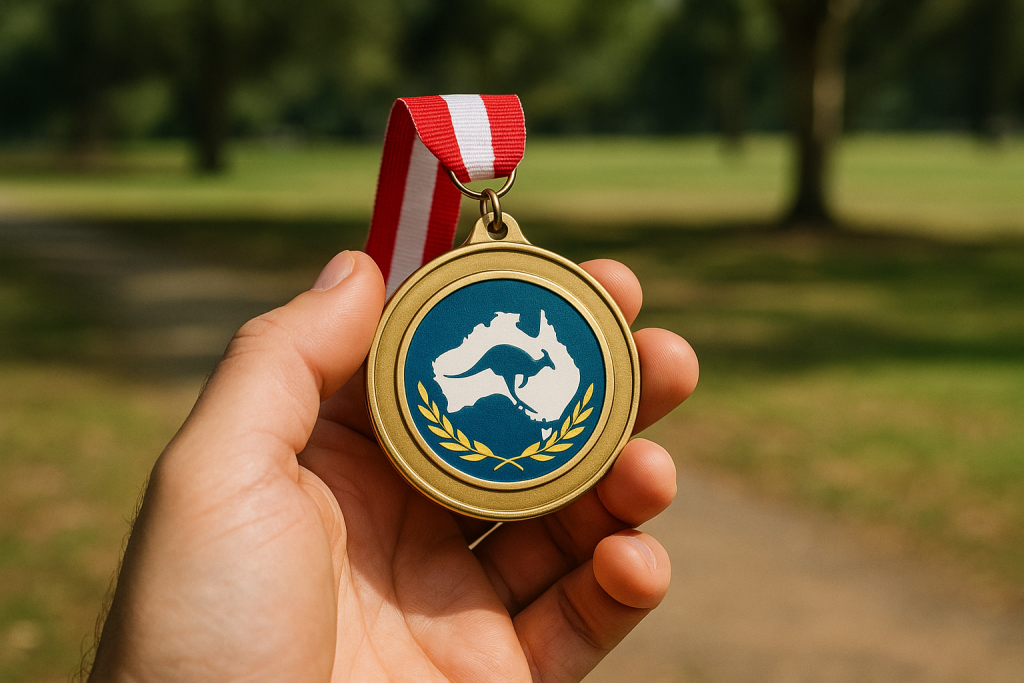
Did You Know? Custom Medals with Logos: Design Ideas for Australian Clubs
21/08/2026Custom medals with logos give sporting clubs a practical way to recognise achievement while reinforcing their identity. The best designs usually feature a clear version of the club emblem, limited supporting text and colours or finishes that remain easy to distinguish when the medal is viewed at presentation distance.
A club logo can be combined with the competition name, season, award level or sporting imagery, but not every detail needs to appear on the front. Keeping the main design simple and placing secondary information on the reverse, an insert or the ribbon can produce a more balanced result.
Whether you are planning a club championship, junior carnival, milestone presentation or annual tournament, this guide will help you develop a custom medal that looks like it genuinely belongs to your club.
Why Put Your Club Logo on a Medal?
A standard sport medal identifies the activity. A club logo makes the award specific to the people and organisation behind it.
Logo medals can be suitable for:
- Club championships
- Premiership and finals presentations
- Annual tournaments
- Junior participation programs
- Player milestones
- Representative competitions
- Club anniversaries
- Volunteer recognition
- School sporting carnivals
- Fundraising runs and community challenges
- Limited-edition awards
- Best and Fairest or Club Champion recognition
Using the club emblem also gives recurring events a recognisable visual identity. If the basic design remains consistent each year, the season or competition details can be updated while preserving a familiar style.
Before developing a custom option, clubs can compare the existing sports medal range from Burswood Trophies. A personalised stock medal may suit some events, while a fully custom design may be more appropriate when the club’s identity is central to the award.
Start with the Right Logo Artwork
Good medal design begins with suitable artwork. A logo that looks sharp on a website banner may not automatically reproduce well at medal size.
Use the Clearest Version Available
Provide the original logo file wherever possible. Vector artwork is often useful because it can be resized without becoming pixelated. If vector artwork is unavailable, supply the largest, clearest version held by the club rather than downloading a small image from social media.
Avoid sending:
- Blurry screenshots
- Photographs of embroidered uniforms
- Logos copied from a website header
- Images with unwanted backgrounds
- Artwork that has been stretched or compressed
- Files where important parts of the emblem are already difficult to read
If your club has several approved logo versions, discuss which one will work best within the medal’s available design area.
Check Small Details
Fine lines, tiny lettering, complex mascots and intricate borders can lose clarity when reduced. It may be necessary to use a simplified version of the emblem while retaining its recognisable features.
This does not mean redesigning the club’s identity. It means adapting the approved artwork so that the final medal remains legible.
Confirm Permission to Use the Artwork
Make sure the club has authority to reproduce every element included in the design. This is particularly important when a logo contains a sponsor’s mark, competition branding or artwork owned by another organisation.
Custom Medal Design Ideas for Clubs
The right concept should reflect both the club and the achievement being recognised. These ideas can be adapted for different sports and presentation styles.
1. Logo as the Main Feature
Place the club emblem in the centre with a simple border around it. Add the event name and season around the edge or on the reverse.
This approach suits clubs with a strong, recognisable logo and avoids overcrowding the design.
A clear hierarchy could be:
- Club logo
- Event or award name
- Year or season
- Placing or recipient details
2. Logo Combined with a Sporting Symbol
Pair the club emblem with a ball, goal, racquet, swimmer, runner or other activity-related symbol. This makes the medal specific to both the organisation and the sport.
The supporting symbol should not compete with the logo. It can be placed in the background, incorporated into the border or used as a smaller secondary feature.
3. Club Colours as the Main Design Element
Club colours can appear through printed artwork, coloured accents, inserts or ribbon selection, depending on the medal and personalisation method.
When using several colours, prioritise contrast. Light text on a pale background or dark details over a similarly dark colour can become difficult to read. A strong outline or simpler colour arrangement may improve clarity.
4. Gold, Silver and Bronze Logo Sets
For ranked competitions, use the same club-branded design across gold, silver and bronze versions. This creates a complete presentation set while allowing each placing to be recognised immediately.
Keep the logo size, text and ribbon style consistent across the three medals. If needed, add “1st”, “2nd” and “3rd” to make the result even clearer.
5. Event-Specific Medal Designs
An annual tournament or carnival may benefit from its own identity. The design can incorporate:
- The club logo
- Tournament name
- Host location
- Year
- Event symbol
- Competition division
Avoid including so much information that the logo becomes difficult to see. Less important details can be placed on the reverse or included in the engraving.
6. Anniversary or Milestone Medals
For a significant club anniversary, the medal can combine the current emblem with the anniversary number or date range.
A restrained commemorative element usually works better than trying to reproduce the entire club history. The front might feature the logo and anniversary mark, with a short message or event details on the reverse.
7. Logo Medal with a Custom Ribbon
The medal itself is only one part of the design. A coordinated ribbon can carry the club colours or repeat the organisation’s identity.
Even when a fully printed or branded ribbon is not required, choosing a ribbon that complements the logo can make the overall award feel more deliberate. Consider how the ribbon and medal will appear together rather than selecting them separately.
Decide What Belongs on the Front and Reverse
Trying to fit the logo, club name, event, date, placing, division and recipient’s name onto one small surface usually creates a crowded result.
A better information hierarchy is:
Front
- Club logo
- Event title or award category
- Essential visual elements
Reverse or Personalisation Area
- Recipient’s name
- Placing
- Division or age group
- Season or date
- Short recognition message
For example:
Front:
Club logo
2026 Club Championships
Reverse:
U16 Division
Second Place
Taylor Morgan
The exact layout will depend on the chosen medal and available personalisation area, so finalise the required wording before approving the design.
Choose a Personalisation Method That Suits the Design
Different logos and medal styles may require different forms of personalisation.
Burswood Trophies completes personalisation in-house using methods that include laser engraving, dye sublimation, glass etching, hand engraving and full-colour glass printing. The appropriate option will depend on the medal, artwork, material and desired appearance.
As a general planning principle:
- A simple, single-colour logo may suit engraving.
- A detailed emblem may require simplification.
- A colourful club identity may benefit from a full-colour personalisation method.
- Recipient details may be added separately from the front logo design.
- Very small lettering should be avoided where readability is important.
Rather than selecting a technique first, show the supplier the logo and explain the desired result. This allows the artwork and medal to be considered together.
How to Plan a Custom Club Medal Order
A structured brief helps the design and ordering process run more smoothly.
Step 1: Define the Purpose
Confirm what the medal will recognise and who will receive it. A participation medal has different design requirements from a Club Champion or premiership award.
Step 2: Set the Award Levels
Decide whether you need:
- One finish for all recipients
- Gold, silver and bronze place medals
- Different designs for champions and participants
- Separate colours for age groups or divisions
Step 3: Gather Approved Artwork
Collect the best available logo files and confirm that the colours and wording are current. Identify any elements that must not be changed.
Step 4: Prepare the Text
Write the exact event name, dates, season and award categories. Decide which details belong on the front and which can be engraved elsewhere.
Step 5: Calculate Quantities
Prepare a breakdown by medal type, finish, team, division or age group. For team awards, confirm whether each eligible player receives a medal.
Step 6: Review the Design at Actual Size
A design can look impressive when enlarged on a screen but become difficult to read at medal size. Pay particular attention to small lettering, thin lines and the space between elements.
Step 7: Proofread Every Variable Detail
Check names, divisions, years and placings. Ask another club representative to review the final information before approval.
For more detailed preparation advice, see the custom medal design and ordering guide.
Creating a Consistent Club Awards Range
Custom medals do not need to stand alone. They can form part of a broader awards range that includes trophies, cups, plaques and perpetual awards.
A club might use:
- Custom logo medals for player participation or tournament placings
- Larger trophies for Best and Fairest or MVP
- A perpetual shield for Club Champion
- Engraved plaques for coaches and volunteers
- Presentation boxes for major individual honours
Repeating the logo, club colours or engraving style across these items helps create a consistent presentation without requiring every award to be identical.
Burswood Trophies can manufacture trophies when required, which gives clubs another option when a standard award does not suit the recognition program.
Common Design Mistakes to Avoid
A few decisions can reduce the clarity or usefulness of a custom medal:
- Using a low-resolution logo
- Including too much text on the front
- Making the season more prominent than the club identity
- Reproducing tiny lettering from the original logo
- Using colours with insufficient contrast
- Changing an approved logo without the club’s consent
- Adding sponsor artwork without confirming permission
- Forgetting to plan gold, silver and bronze quantities separately
- Reviewing the design only at an enlarged screen size
- Submitting engraving names across several messages or documents
The strongest design is not necessarily the most detailed. It is the one recipients can identify, understand and connect with immediately.
Presentation Ideas for Custom Logo Medals
Good presentation reinforces the work put into the design.
Before the ceremony:
- Arrange medals by award category and presentation order.
- Keep complete team sets together.
- Check that ribbons are attached consistently.
- Confirm names and engraving against the results list.
- Display the club logo behind or near the presentation area.
- Brief presenters on the meaning of special medal designs.
- Consider suitable presentation boxes for major individual awards.
For a commemorative or limited-edition medal, the presenter may briefly explain the design concept. This helps recipients understand why particular colours, symbols or dates were included.
Frequently Asked Questions
Can any club logo be added to a medal?
It depends on the quality, complexity and ownership of the artwork, as well as the medal and personalisation method. Supply the clearest approved version of the logo so its suitability can be assessed.
Should a custom medal include the recipient’s name?
Individual names can make an award more personal, but they are not essential for every event. Large tournaments may use a standard event design, while major club awards may include individual engraving.
Can club colours be reproduced on a medal?
Colour personalisation may be possible depending on the chosen design and production method. Provide official colour references or approved artwork rather than relying on colours copied from a screenshot.
What information should be included in the design brief?
Include the logo files, event name, season, medal quantities, award levels, required wording, preferred colours and any relevant presentation date. Clearly identify details that cannot be altered.
Should gold, silver and bronze medals use different designs?
Using the same design in three finishes usually creates the strongest set. If the designs differ, keep the logo, size, text layout and ribbon treatment consistent.
Create a Medal That Represents Your Club
Custom medals with logos work best when they are clear, recognisable and designed for the space available. Start with approved artwork, make the club emblem the visual priority and move secondary information away from the main design when necessary.
Burswood Trophies has operated since 2000 and is owned and run by Mick and Charmaine Rogers. With more than 30 years of involvement in sporting clubs, the family-run team understands the practical requirements of club award orders. Engraving and personalisation are completed in-house, and the business serves customers from its Burswood showroom and through Australia-wide delivery.
Clubs can browse the medal collection, review the online catalogues or contact Burswood Trophies to discuss logo artwork and custom award ideas.