
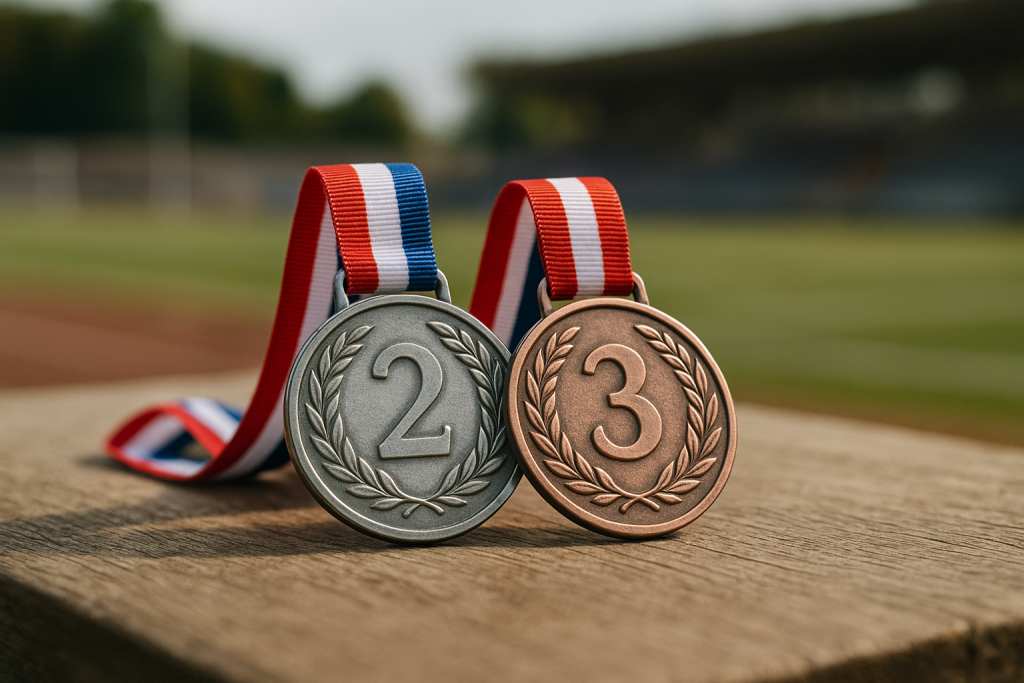
Silver and Bronze Medal Awards: Creating a Complete Presentation Set
21/08/2026Silver and bronze medal awards are essential parts of a traditional first-, second- and third-place presentation. When they are selected alongside a matching gold medal, the three awards communicate the final rankings instantly and give each placegetter recognition that feels considered.
A complete presentation set requires more than ordering three different colours. The medals should share the same design, size, ribbon style and personalisation format wherever possible. Organisers also need to confirm quantities, engraving details and how the medals will be arranged during the ceremony.
This guide explains how Australian schools, sporting clubs, businesses and event organisers can create a coordinated gold, silver and bronze medal set without overlooking the practical details.
Why Silver and Bronze Medals Matter
Gold may represent first place, but a competition is not complete without meaningful recognition for the other placegetters.
A silver medal recognises the competitor or team finishing second, while bronze traditionally marks third place. These awards acknowledge achievement at the top end of a field and give recipients a physical reminder of their performance.
Ranked medal sets are commonly suitable for:
- School athletics and swimming carnivals
- Club championships
- Junior and senior sporting tournaments
- Dance and performing arts competitions
- Academic challenges
- Community events
- Workplace competitions
- Multi-event championships
- Esports and recreational competitions
- Fundraising activities with competitive categories
Before ordering, decide whether the event will recognise three places in every category. Applying the same structure consistently helps participants understand how results will be acknowledged.
Start with a Matching Gold, Silver and Bronze Set
The easiest way to create a professional presentation is to select medals that are available as a coordinated gold, silver and bronze set.
The three medals should ideally have:
- The same diameter and shape
- Matching borders and design details
- Consistent sport or activity imagery
- The same engraving or insert area
- Coordinated ribbons
- Clearly distinguishable finishes
Using unrelated designs for each placing can make the presentation feel improvised. A matching set keeps the focus on the achievement and makes the finishing order easy to recognise in photographs and on the presentation table.
Burswood Trophies offers a broad range of medals for sports, schools and achievement awards. Organisers can compare suitable designs for different activities and levels of competition.
Choosing the Right Medal Style
The best design depends on the event, the recipients and the message the award needs to convey.
Sport-Specific Medals
A medal featuring the relevant sport helps recipients identify the achievement immediately. These designs can work particularly well for club competitions, school carnivals and end-of-season presentations.
Sport-specific medal categories available through Burswood Trophies include athletics, basketball, cricket, golf, hockey, netball, soccer, swimming, tennis and many other activities.
General Achievement Medals
A general achievement, victory or place medal is useful when one design needs to work across several activities. This can simplify ordering for school programs, corporate events, community competitions and multi-sport tournaments.
It also provides flexibility when the event has no suitable activity-specific emblem.
Custom Medals
For an annual tournament, championship or branded event, a custom medal can create a stronger connection to the organisation. Depending on the design requirements, personalisation may incorporate an event name, club identity, logo, colours or other relevant artwork.
Burswood Trophies can manufacture trophies when required and offers several in-house personalisation methods. Event organisers considering a unique design can review the custom medals planning guide before discussing their requirements.
Make Second and Third Place Easy to Distinguish
Silver and bronze medals need to be visually distinct from each other and from the gold award. Colour is the main indicator, but it should not be the only consideration.
Check the medals under the type of lighting likely to be used at the event. Some finishes can appear more similar under dim indoor lighting or strong reflections. Clear engraving, inserts or labels can provide additional confirmation.
For events involving young children or a fast-moving presentation schedule, consider arranging medals in separate, clearly marked sections:
- First place — gold
- Second place — silver
- Third place — bronze
This reduces the chance of the wrong medal being presented and helps volunteers manage multiple categories efficiently.
It is also worth checking the product description or discussing the medal with the supplier if its precise material or finish matters to your event. “Gold”, “silver” and “bronze” frequently describe the award level and appearance, so organisers should not assume those terms indicate precious-metal content.
Plan Medal Quantities Carefully
Incorrect quantities are one of the easiest ways to disrupt a presentation. Begin with a complete list of divisions, events and recipient numbers before placing the order.
A practical medal schedule might include columns for:
| Event or category | Gold required | Silver required | Bronze required |
|---|---|---|---|
| Junior division | 1 | 1 | 1 |
| Intermediate division | 1 | 1 | 1 |
| Senior division | 1 | 1 | 1 |
| Team event | Number of team members | Number of team members | Number of team members |
For team competitions, confirm whether every player receives a medal or whether one medal is presented to the team. If individual medals are required, check the number of players in each squad rather than ordering only one set per placing.
Also consider ties, reserves, officials or any additional recognition included in the event rules. Do not add extras automatically if they are unnecessary, but make sure the order reflects every outcome your competition allows.
Coordinate Medal Ribbons with the Set
Ribbons are both functional and visual. A consistent ribbon style can bring the three medal levels together, even when their finishes differ.
When selecting ribbons, consider:
- Whether the ribbon colour suits the event or organisation
- Whether all three place medals should use the same ribbon
- Whether different ribbon colours would make rankings clearer
- How the medal and ribbon will appear against clothing
- Whether the assembled medals can be arranged without tangling
For a formal event, neutral or organisation-aligned colours can create a coordinated appearance. For a junior carnival or community competition, brighter ribbons may suit the occasion.
The most important point is consistency. If each place uses a different ribbon, make that decision deliberately and repeat it across every category.
Personalising Silver and Bronze Medal Awards
Personalisation helps explain exactly what the recipient achieved. The available space on a medal is limited, so engraving should be concise and easy to read.
Depending on the chosen medal and personalisation area, useful details might include:
- Event or competition name
- Award category
- Age group or division
- Recipient’s name
- Place achieved
- Year or season
- Club, school or organisation name
For example:
Perth Junior Athletics
U14 High Jump – 2nd Place
2026
If individual names are not known until close to the event, organisers may choose to engrave the event and category rather than each recipient. The right approach depends on the format of the competition and the selected medal.
Burswood Trophies completes engraving and personalisation in-house. Available services include laser engraving, dye sublimation, glass etching, hand engraving and full-colour glass printing. The appropriate method will depend on the medal, insert, artwork and required result.
For additional preparation advice, see the guide to choosing and ordering engraved medals.
How to Prepare Accurate Engraving Information
A clear engraving list helps reduce confusion when several categories and place levels are involved.
Use a spreadsheet with separate columns for:
- Event or division
- Recipient’s name, if required
- Placing
- Exact engraving wording
- Medal finish
- Quantity
- Ribbon selection
- Special artwork or logo requirements
Do not rely on colour coding alone, as colours may not remain visible when a document is printed or shared. Write “gold”, “silver” or “bronze” in a dedicated column.
Before submitting the order, ask another organiser to check:
- Names and spelling
- Dates and seasons
- Age groups
- Division names
- First-, second- and third-place labels
- Total quantities
- Consistency of capitalisation and punctuation
If the same wording appears across several medals, confirm exactly which details change between categories.
Presentation Boxes and Display Options
A presentation box can give an important medal additional prominence and keep it protected before and after the ceremony. It may be appropriate for a championship, service award, commemorative medal or small number of major placegetters.
For a large carnival involving many recipients, placing every medal in a box may be less practical. Instead, medals can be organised on trays, display boards or clearly labelled tables in presentation order.
If boxes are being considered, confirm that the chosen box is suitable for the medal and its ribbon. Burswood Trophies offers a selection of presentation boxes that organisers can review alongside their medals.
Preparing the Complete Set for Presentation Day
Good organisation helps the ceremony run smoothly, particularly when many age groups or events are being presented.
Before the event:
- Check the number of gold, silver and bronze medals against the results list.
- Inspect the personalisation for spelling and category accuracy.
- Attach or arrange ribbons consistently.
- Separate medals by event and placing.
- Place the medals in presentation order.
- Brief the presenters on how the awards are organised.
- Keep team medal groups together.
- Ensure any presentation boxes are matched to the correct recipients.
Avoid opening or sorting large quantities for the first time immediately before the ceremony. A structured check beforehand gives organisers time to identify missing information or incorrectly arranged awards.
Common Mistakes to Avoid
Creating a medal set is straightforward when the details are planned, but several common errors can affect the final presentation:
- Ordering matching colours but different medal designs or sizes
- Forgetting that a team placing may require multiple medals
- Using inconsistent wording for equivalent categories
- Assuming a finish refers to the medal’s underlying material
- Choosing ribbons without considering the overall presentation
- Supplying engraving information in several separate messages
- Failing to distinguish second and third place clearly on the order
- Mixing categories together before presentation day
- Selecting presentation boxes without confirming compatibility
A single, checked order document is usually easier to manage than information supplied across emails, handwritten notes and messaging threads.
Frequently Asked Questions
Do silver and bronze medals need to match the gold medal?
They do not have to, but a matching design creates a more complete and professional presentation. Using the same size, shape and artwork also makes the rankings easier to compare.
Should second and third place be engraved on the medals?
The different finishes often communicate the placing, but adding “2nd Place” or “3rd Place” can remove ambiguity and provide a clearer record of the achievement.
Can individual names be added to medals?
Personalisation depends on the selected medal and its available engraving or insert area. Discuss the required wording before finalising the design.
How many medals are needed for a team event?
That depends on your competition rules. If every team member is to receive an award, order according to the number of eligible players in each gold, silver and bronze team.
Are presentation boxes necessary?
No. They can enhance major or formal awards, but organised trays or display tables may be more practical for events presenting a large number of medals.
Complete Your Presentation with Confidence
Silver and bronze medal awards deserve the same planning as the first-place prize. Together with a coordinated gold medal, they create a complete presentation set that clearly recognises the event’s leading competitors.
Start by choosing a matching design, calculate quantities by category and recipient, keep engraving concise, and organise every medal in presentation order. These simple steps can make a school carnival, club championship or awards ceremony easier to manage and more meaningful for the recipients.
Burswood Trophies has operated since 2000 and is owned and run by Mick and Charmaine Rogers. With more than 30 years of involvement in sporting clubs, the family-run team understands the practical requirements behind multi-category award orders. Personalisation is completed in-house, and customers can visit the Burswood showroom or arrange delivery across Australia.
Explore the medal collection or contact Burswood Trophies to discuss a coordinated gold, silver and bronze presentation set.